
Haute-Sorne: Building Sustainable Shallow Geothermal Heating Solutions to transform a Municipality
A comprehensive energy planning initiative to transform the commune of Haute-Sorne’s heating infrastructure, achieving a 91% reduction in CO2 emissions through strategic deployment of sustainable building heating solutions and advanced geospatial analysis.
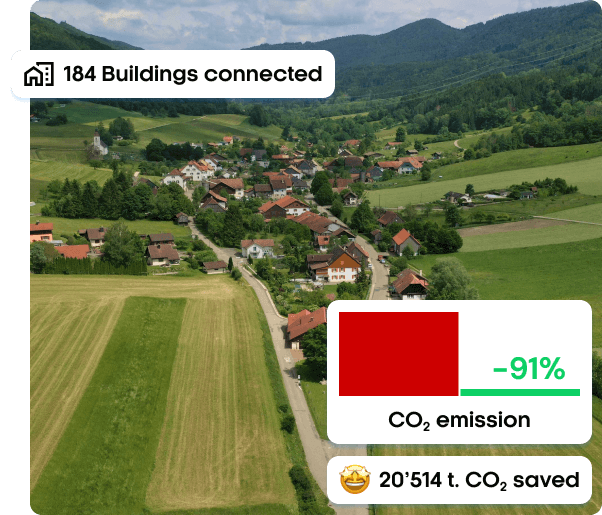
91%
CO2 Emission Reduction
80%
Coverage Efficiency
184
Buildings Connected

Partner
Geoimpact AG
Geoimpact AG
Project
184 buildings
Heated Surface Area
857,162 m²
Annual Energy Demand
103 GWh/year
Location
Haute-Sorne, Switzerland
Company details
Geoimpact AG is a Swiss territorial energy planning specialist providing comprehensive solutions from analysis through implementation across Bern, Zürich, and Basel regions.
The challenge
The commune of Haute-Sorne faced the complex challenge of bringing sustainability to its heating system across a diverse building portfolio. With 103 GWh of annual energy demand distributed across nearly one million square meters of heated space, the municipality needed a data-driven approach to:
- Identify optimal district heating network locations across diverse building typologies
- Quantify potential CO2 emission reductions
- Evaluate economic feasibility of different heating technologies and scenarios
- Prioritize investments for maximum CO2 emissions reduction impact
Traditional heating solution planning lacked the granular analysis needed to optimize network topology and technology selection at territorial scale.
The solution
Geoimpact deployed TESSA clustering technology to conduct comprehensive geospatial energy analysis of Haute-Sorne’s building stock. Prioritizing the sustainable heating solution to buildings with the highest emissions. The methodology combined:
1. Advanced Clustering Analysis
Thanks to TESSA algorithms, Geoimpact identified 5 optimal district heating zones by analyzing building density, energy demand patterns, and infrastructure constraints, representing 80% of municipal emissions.
2. Hybrid System Design
Engineered ground source heat pump baseload (2 MW) with wood pellet peak coverage (150 kW) for the priority cluster, ensuring 100% renewable energy integration.
3. Heating Network Optimization
Designed 4.74 km pipeline system connecting 184 buildings in the highest-impact zone, utilizing meshed thermal distribution with multiple injection points.
4. Economic Modelling
Comprehensive investment cost analysis and levelized energy cost calculations provided clear financial projections for municipal decision-making.
5. Impact Quantification
Detailed CO2 emission modeling demonstrated the environmental benefits of transitioning from individual heating systems to a sustainable optimized heating solution.