
Planeto

Everything you do in EWS — connected to your whole district energy project.

EWS sizes a borehole field. Planeto sizes the same borehole field — SIA 384/6 depth, temperature profile, thermal resistance — then wires it straight into your network design, heat pump sizing and financial report, in a browser, with no per-PC license.

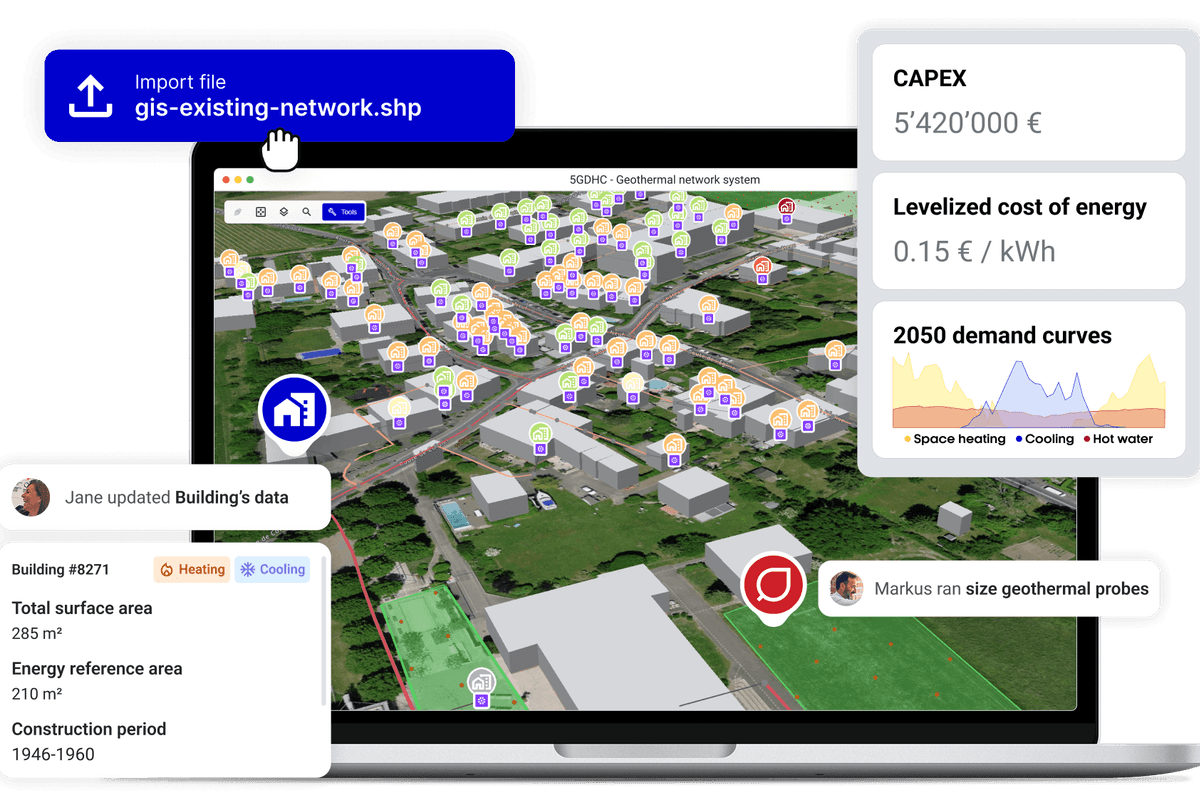
Planeto network design interface

Every EWS calculation, plus the network around it

You already know how to size a borehole field in EWS. Planeto runs the same core physics — then keeps the result connected to the rest of the project instead of leaving it in a standalone file.

Borehole depth & temperature profile In EWS In Planeto

Required borehole length, inlet/outlet temperature and heat extraction rate, calculated in hourly time steps — the same core calculation as EWS.

Custom borehole field layout In EWS In Planeto

Place boreholes freely on the plan rather than a fixed grid, with no cap at 600 — Planeto scales to district-sized fields.

Direct cooling & heating without a heat pump In EWS In Planeto

Model borehole fields hydraulically linked to TABS, cooling ceilings or ventilation, without a heat pump in the loop.

Fluid properties & average SEER In EWS In Planeto

Configure antifreeze/fluid properties and get average seasonal performance for the borehole-to-heat-pump system.

Load import from building data In EWS In Planeto

Bring in heating/cooling demand from a building or district instead of typing a load profile by hand.

Report of results In EWS In Planeto

Get a report of boundary conditions and results — in Planeto, as part of the same document as the rest of the project, not a separate PDF.

Beyond EWS

EWS is a single-purpose Windows tool for one borehole field at a time. Planeto is where that same borehole field becomes one heat source inside a full district energy project.

Borehole Fields Inside Full Network Design

Borehole Fields Inside Full Network Design

Your sized borehole field becomes a heat source in the same model as the pipe network, hydraulics and other sources — including 5G DHC loop and meshed configurations. EWS stops at the field. Planeto keeps designing the network around it.

Only in Planeto
Investment & Operating Cost Built In

Investment & Operating Cost Built In

EWS has no cost calculation. Planeto turns the same borehole field into CAPEX/OPEX estimates and a bankable, re-runnable financial report, ready for technical-advisor scrutiny.

Only in Planeto
Cloud SaaS, No Per-PC License

Cloud SaaS, No Per-PC License

No Windows install, no single-workstation license, no paid version upgrades. Planeto runs in the browser, updates automatically, and lets your whole team work on the same project.

Only in Planeto

EWS vs. Planeto

EWSPlaneto
Borehole depth & temperature profile (SIA 384/6)
Hourly load resolution, long-term simulation
Free / custom borehole field layout
Heat delivery units & simultaneity
Direct cooling & heating without heat pump
Dynamic borehole thermal resistance & fluid parameters
Investment & operating cost calculation
Unlimited numbers of boreholes per field
District heating & 5G DHC network design
Multi-source heat pump & energy center sizing
Hydraulic network simulation
Bankable, audit-ready financial report
Real-time, multi-user collaboration
Cloud-based, no installation
Automatic software updates

From EWS to Planeto in 4 steps

Our team handles the heavy lifting. You're up and running fast.

  1. 1

    Book a demo

    See Planeto in action with your use cases. Ask every question.

  2. 2

    Data audit

    We review your existing EWS projects and GIS files together.

  3. 3

    Migration

    Our team integrates your data into Planeto. Discounted for 1 month.

  4. 4

    Onboarding

    Personalised onboarding so your team is productive from day one.

Frequently asked questions

  • What is EWS software used for?

    EWS, developed by Huber Energietechnik AG, is a Windows desktop program for sizing geothermal borehole heat exchangers (Erdwärmesonden). It calculates required borehole depth, inlet/outlet temperatures and heat extraction rates in hourly time steps, and can size borehole fields according to the Swiss norm SIA 384/6.

  • Is there a cloud-based alternative to EWS for borehole field design?

    Yes. Planeto is a browser-based alternative that sizes geothermal borehole fields — with no installation, no per-PC license and no fixed borehole count limit — and connects that sizing directly to district heating network design, heat pump sizing and financial modelling in the same project.

  • Does Planeto support SIA 384/6 borehole field sizing?

    Planeto's geothermal borehole design module calculates required borehole depth, temperature profiles and thermal resistance for vertical borehole fields, built for the Swiss and European engineering practice that SIA 384/6 and VDI 4640 are based on.

  • Can Planeto size borehole fields larger than EWS's 600-borehole limit?

    Yes. EWS Pro caps a borehole field at 600 boreholes. Planeto has no fixed limit, which matters for large district-scale or 5G DHC borehole fields.

  • How does Planeto connect geothermal borehole design to district heating networks?

    In Planeto, a sized borehole field is a heat source object inside the same model as your network layout, pipe sizing, heat pumps and financials — so changing the borehole field updates the network hydraulics and cost report automatically, instead of re-importing results between separate tools.

Ready to move forward?

What our customers say

  • We needed a solution that could support our design decisions and optimize projects from the ground up. We're finally able to do just that—saving time, improving accuracy, and ensuring we make the best possible impact with each project.
    Loic Quiquerez
    Loic Quiquerez
    Expert Advisor in Geothermal Energy and District Heating & Cooling
    SIG
  • I can calculate different variants of district heating and cooling networks 5 times as fast and write the corresponding reports. This helps my customers to make well-founded decisions without having to repeatedly place new orders for variants.
    Nikos Karathanasis
    Nikos Karathanasis
    Engineering Managing Director
    Enersitum Engineering GmbH