

Ask an installer which heat pump you should fit and you will usually get the one they fit most. Ask the internet and you will get a list of bullet points that carefully avoids the only question that matters. That question is not which technology is better, since ground source wins almost every technical comparison, but where the extra money stops being worth it for your building.
That crossover point is real, it is calculable, and it sits in a different place depending on four things: how long you will own the building, whether you need cooling, what your site allows, and what your emitters run at. Here is how to find it.
The difference in one paragraph each
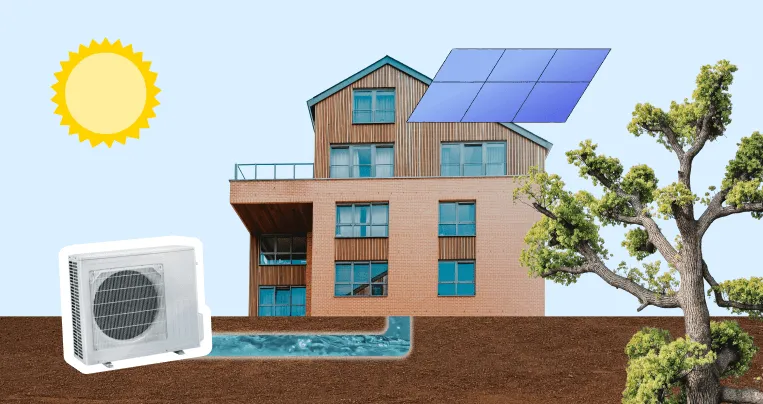
An air-source heat pump extracts heat from outdoor air using an outdoor unit (a fan and a heat exchanger, usually mounted against a wall or standing in the garden) and upgrades it with a compressor. It is straightforward to install, needs no excavation, and can typically be commissioned in a couple of days.
A ground-source heat pump extracts heat from the ground, via vertical boreholes typically 50 to 300 metres deep, or horizontal loops if you have the land. A water-glycol mixture circulates through sealed pipes, picks up heat from the rock, and carries it to a heat pump indoors. There is no outdoor unit at all. The install involves a drilling rig and takes considerably longer.
Same principle, very different source. Everything below follows from that one difference.
Efficiency: the gap is bigger than the headline numbers suggest
Heat pumps are rated by seasonal performance factor (SPF): the heat delivered across a year divided by the electricity consumed.
Ground source and air source, side by side
| Ground source | Air source | |
|---|---|---|
| Typical SPF (space heating) | 4 to 5 | 2.5 to 3.5 |
| Source temperature in January | 8 to 14 °C | −5 to +5 °C |
| Source temperature in August | 8 to 14 °C | 25 to 35 °C |
| Performance on the coldest day | Unchanged | Lowest of the year |
| Defrost cycles | None | Yes, in cold damp weather |
| Installed cost, single house | 2 to 3 times higher | Lowest of the two |
Figures are typical ranges for well-designed systems in temperate European climates. Your numbers will depend on emitters, climate and design.
The averages understate the difference, because of when the gap appears. An air-source unit is least efficient precisely on the coldest morning of the year, when demand peaks. The source it is drawing from has got colder, the temperature lift it must achieve has got bigger, and in damp cold it periodically stops heating your house altogether to melt ice off its own coil. Ground temperature, by contrast, does not care what the weather is doing. The source you sized for in October is the source you have in February.
For the owner this shows up as a heating bill that is roughly 25 to 40% lower, and as a house that stays warm during the week everyone else's system is struggling.
Capital cost: the case for air source
This is where air source wins, and it wins decisively.
Drilling is the dominant line in a ground-source budget and it scales with metres, geology and site access. A ground-source installation for a single house commonly runs two to three times the cost of an equivalent air-source system, occasionally more on a constrained urban plot where a rig has to work in a courtyard. On a tight budget, or where the building will change hands within a few years, that gap is difficult to argue away on running cost alone.
Payback of the extra investment through lower bills typically lands somewhere in the 8 to 15 year range for a heating-only building. That is a long time, long enough that the decision usually hinges on something other than the energy bill.
Which brings us to the three things that actually move the decision.
What actually decides it
1. Cooling changes the arithmetic completely
This is the asymmetry almost every comparison misses.
An air-source heat pump can cool. Run it in reverse and it becomes an air conditioner. But it cools the way an air conditioner does: the compressor runs, the outdoor unit runs, it consumes serious electricity on the hottest afternoons, and it dumps heat into a street that is already too hot.
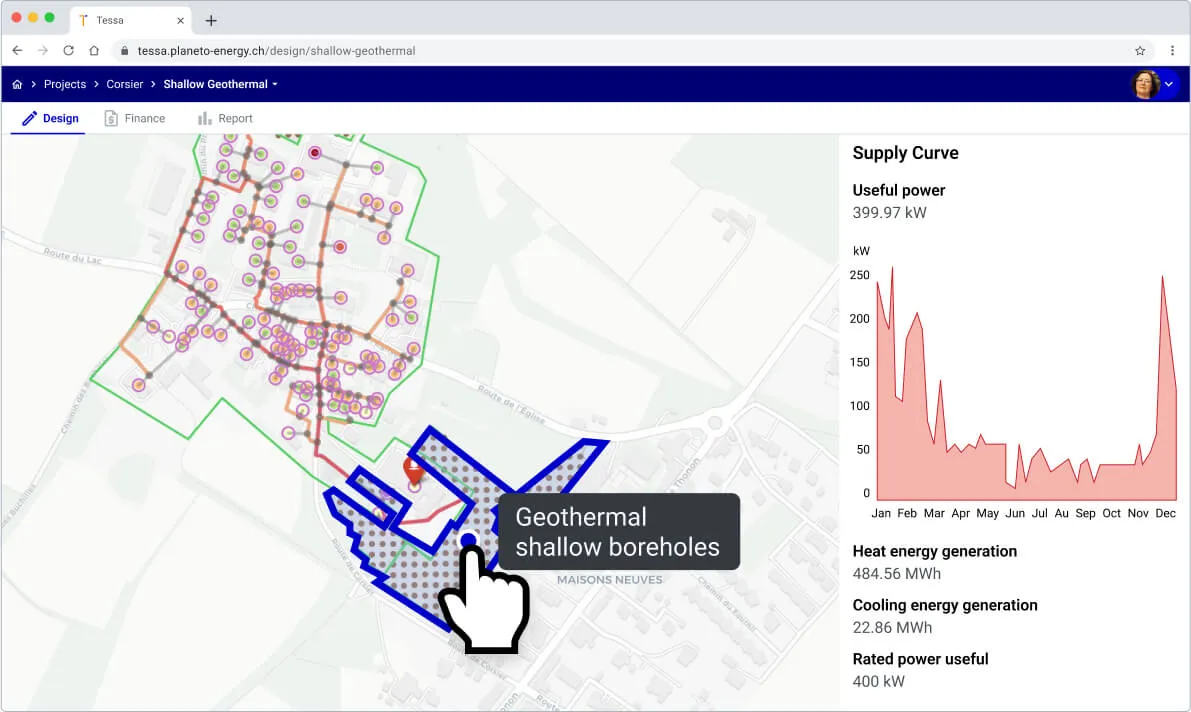
A ground-source system cools without a compressor at all. Warm water from the building's floor or ceiling circuits is passed against the cold brine from the boreholes through a heat exchanger. Only a circulation pump runs. Delivering a unit of cooling this way typically costs a small fraction of what a compressor would use, commonly cited as a twentieth to a fortieth.
Three consequences follow:
- Running cost. Summer cooling is close to free. In a building with real cooling demand, this alone can halve the payback period of the ground-source premium.
- Regulation and planning. Across much of Europe, active comfort cooling faces scrutiny that passive geocooling does not: capacity limits in energy codes, requirements to justify the need, restrictions on visible outdoor units, boundary noise limits, and a tightening refrigerant regime. Owners who set out to install air conditioning frequently find the answer is no. Geothermal cooling often passes where a conventional system fails, because there is no outdoor unit, no noise, and almost no electricity involved. (Rules vary considerably by country and municipality, so check your site.)
- System life. Pushing summer heat into the ground regenerates it, counteracting the slow temperature drift that heating-only borehole fields suffer over decades. Cooling does not wear a ground-source system out. It preserves it. We cover this in depth in our guide to shallow geothermal heating and cooling.
If your building needs cooling (and if it is well-insulated, modern, glazed, or has top-floor flats, it probably does), the comparison stops being close.
2. Noise, neighbours and permission
An air-source outdoor unit makes noise. Not a lot, but continuously, outdoors, near a boundary, at night in winter. In detached houses with space this is a non-issue. In terraces, courtyards, dense urban streets and conservation areas it is frequently the issue: boundary noise limits and visual amenity rules are the most common reason an air-source installation is refused or has to be relocated somewhere less efficient.
A ground-source system has nothing outside. Nothing to see, nothing to hear, nothing to argue about. Where planning constraints are tight, this sometimes is not an advantage so much as the only route to a heat pump at all.
3. How long you'll hold the building
Payback periods of a decade only matter if you are there for the decade. For a developer selling on completion, air source is usually the rational choice unless cooling or planning forces the issue. For an owner-occupier, a housing cooperative, or an institutional landlord holding for thirty years, the arithmetic reverses, and the borehole itself is credited with a 50 to 100 year service life, against 15 to 20 for an air-source outdoor unit exposed to the weather.
Where ground source simply isn't available
Honesty requires the reverse case. Ground source is off the table, or heavily compromised, when:
- You can't drill. Drinking-water protection zones, certain geological formations, contaminated ground and some urban subsurface congestion make boreholes restricted or prohibited. Many regions publish admissibility maps; check yours before anything else.
- The plot is too small. Boreholes need meaningful separation from each other and from boundaries, or they steal heat from one another.
- There's no rig access. A drilling rig needs to physically reach the spot.
- The permit timeline doesn't fit. Several months is normal. If the boiler died last week, that is not the constraint you want.
- The emitters are high-temperature. This one applies to both technologies, but bites harder on the ground-source business case: if the building runs radiators at 65 to 70 °C, no heat pump will deliver its rated efficiency, and you will have spent ground-source money for air-source performance. Fix the emitters first, or don't drill.
A rough decision framework
Choose air source if the building is heating-dominated, the budget is tight, you're selling within a few years, the site can't be drilled, or you have outdoor space away from neighbours.
Choose ground source if you need cooling, noise or planning rules block an outdoor unit, you're holding the building long-term, you already have or are installing low-temperature emitters, or (the case owners most often overlook) there is more than one building.
Consider a hybrid where peak heating demand is large but brief: a ground-source system sized for the bulk of the year with a small backup for the coldest hours is often cheaper than drilling for the 1% case.
The case owners overlook: more than one building
If you own or are developing several buildings on one site, the comparison changes again. Individual air-source units mean one outdoor unit per building, each sized for its own peak. A shared ground loop serving all of them needs far less total capacity, because the buildings don't peak simultaneously, and because a building that needs cooling can regenerate the ground for one that needs heat. The plant room consolidates. The cost per building falls, sometimes sharply.
This is the point where the decision stops being a product comparison and becomes a design problem, and where it is worth modelling properly before committing to anything.
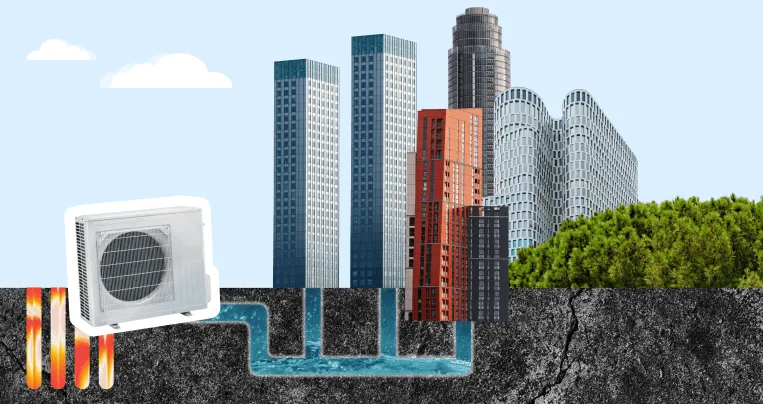
That modelling is what Planeto does. Our platform, Tessa, brings building demand, ground conditions, sources and costs into a single model, so options like these can be built and compared in hours rather than weeks.
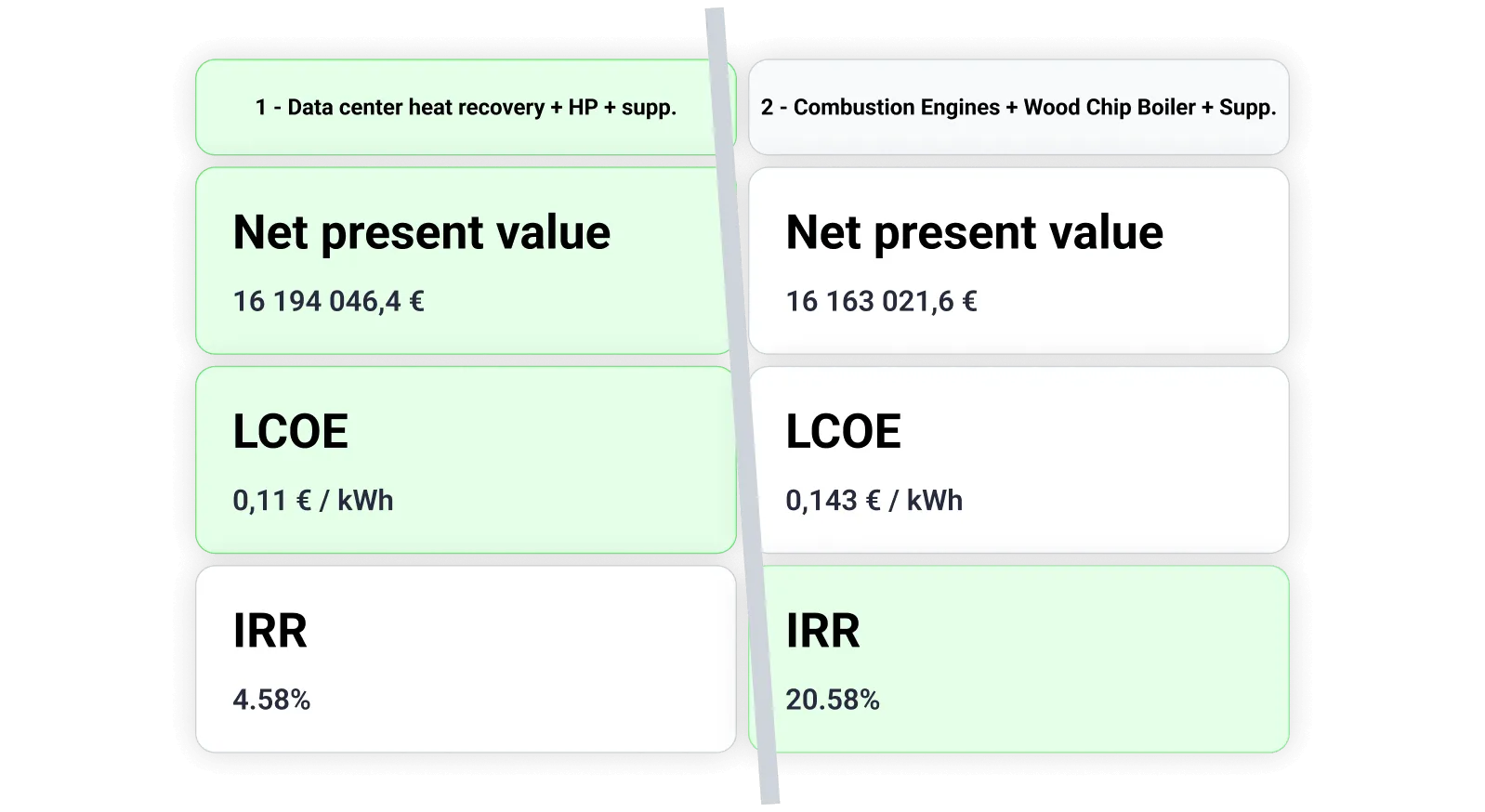
And if you don't have a planning office engaged yet, our energy engineers can run the comparison with you, or tell you straight away whether your site rules one of the options out.
Frequently asked questions
Is a ground-source heat pump always more efficient than air source?
In practice, yes. The ground is a warmer and far more stable source in winter. Typical SPFs are 4 to 5 against 2.5 to 3.5 for air source. The real question is whether the efficiency gain repays the drilling cost within your ownership horizon.
Can both types provide cooling?
Both can, but very differently. Air source cools with a compressor, like air conditioning. Ground source can cool passively with only a circulation pump, at a small fraction of the electricity and with no outdoor unit, which matters both for running cost and for getting permission.
How much more does ground source cost?
Commonly two to three times an air-source installation for a single house, driven almost entirely by drilling. The gap narrows in buildings with cooling demand and across multiple buildings on one site.
Does an air-source heat pump work in cold weather?
Yes, modern units operate well below freezing, but efficiency falls as it gets colder and defrost cycles begin, so output is lowest exactly when demand is highest. Sizing has to account for this.
Which lasts longer?
Boreholes are credited with 50 to 100 years and the ground-source heat pump itself with 20 to 25. An air-source outdoor unit typically lasts 15 to 20 years, being weather-exposed.